
Old Greg's Tavern
Old Greg's TavernRole Playing
4.6315.00 Reviews
- Version
- 1.4.1
- Installs
- 50.00K
- Age Rating
- Mature 17+
Screenshots

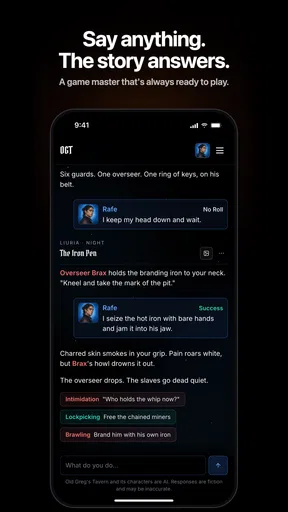
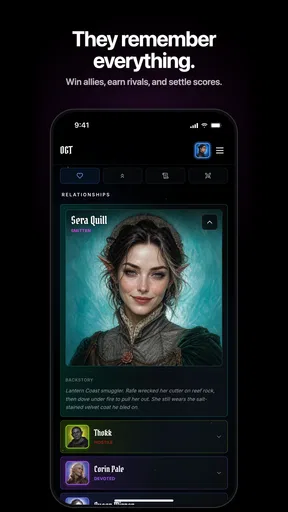
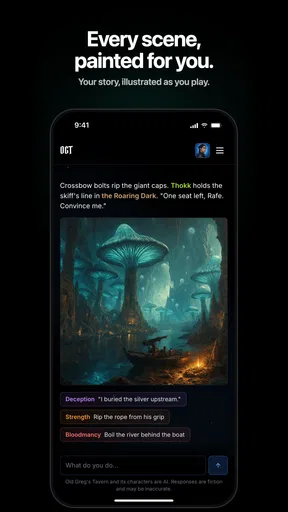
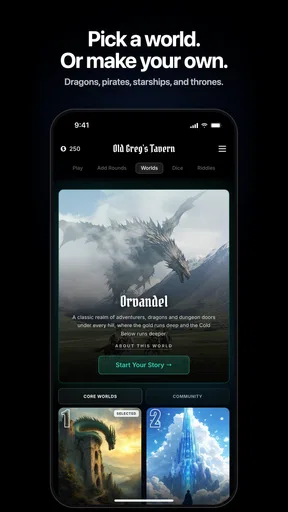
Our Review of Old Greg's Tavern
 Analysis by Appyee
I went into Old Greg's Tavern expecting a compact role-playing game built around short solo sessions, and that is the right way to approach it. It is free to start, aimed at mature players, and comes from Old Greg's Tavern rather than a large publisher with a familiar franchise behind it. The appeal is simple: you can open it when you have a little time, make progress on your own, and return later without needing a group or a fixed appointment.
That simplicity is also where the game needs to be judged carefully. A solo RPG can feel wonderfully convenient when its pace matches your routine, but it can become repetitive or demanding if you want a large social world, cinematic presentation, or a carefully guided story. After spending time with it, I see this as a game for players who enjoy checking decisions, managing a run, and gradually improving their approach rather than chasing a dramatic multiplayer experience.
How the game feels in everyday play
The most useful way to understand this release is to imagine a normal day. I would play it during a short break, make a few choices, stop before the session became a commitment, and return later when I wanted something interactive but not socially demanding. That “pick up and continue” quality is central to its identity. It does not ask me to organize a party, wait for other players, or reserve a long uninterrupted evening.
The role-playing label matters because the enjoyment comes from the decisions around a character and a continuing run, not merely from tapping through isolated mini-games. I found the best moments came when I treated each session as a small planning exercise: consider what I was trying to accomplish, avoid wasting an opportunity, and accept that a cautious choice can be better than an exciting one. Players who like that rhythm will probably get more from it than people looking for constant spectacle.
It is also worth setting expectations about presentation. The store summary positions it as an infinite dungeon RPG for solo play, so the core promise is ongoing replay rather than a short, tightly authored campaign. That can be liberating because there is no pressure to rush toward a final chapter. At the same time, an endless structure needs variety from the player’s own decisions. If you need a strong narrative conclusion or a clearly defined ending, a conventional story RPG may suit you better.
Speed expectations before you settle in
My impression is that the game is most comfortable when treated as a measured, repeatable experience rather than a reflex test. The important question is not whether every moment feels frantic, but whether the interface lets you move from one decision to the next without making a short session feel like administrative work. For a phone game designed around solo dungeon play, that distinction is important: quick access is valuable, but useful pacing is what makes returning worthwhile.
I would not choose it specifically for high-speed action. Its stronger use case is the player who wants to think, make a choice, see how that choice affects the run, and then decide whether to continue. That makes it suitable for a commute, a quiet lunch break, or a few minutes at home. It is less suitable when I want immediate visual intensity or a game that rewards rapid reactions every second.
A practical tip is to begin with shorter sessions instead of trying to push as far as possible immediately. That gives you time to learn the game’s rhythm and notice where your attention starts to fade. In an ongoing dungeon game, tired decisions can be more damaging than slow decisions. I found that stopping while I still understood my plan made the next session feel more purposeful than playing until every choice became automatic.
What happens during heavier play
Longer sessions reveal a trade-off that is easy to miss in a store description. The infinite format is attractive because it promises continued play, but it also places more responsibility on the player to create variety. I had to avoid treating every run as a routine checklist. Changing my priorities, testing a different approach, or deliberately playing more conservatively helped keep the process from feeling flat.
This is one of the game’s less obvious strengths: it can turn a small amount of content into a personal decision-making challenge when I pay attention to the consequences of each run. The weakness is that the same structure may feel thin to anyone who expects a steady stream of new characters, locations, or story revelations. I would recommend it more confidently to systems-minded RPG players than to readers who mainly play for dialogue and plot twists.
During a heavy-use session, I would also keep an eye on the practical side of mobile play. Extended RPG sessions are more likely to expose interruptions, battery limits, and the inconvenience of playing on a small screen than a quick five-minute check-in. I would not plan an important run while multitasking or relying on an unstable connection. Even when a game feels lightweight, a serious session deserves the same attention as any other ongoing save or run.
Another useful workflow is to decide your stopping point before opening the game. If you are playing between errands, set a modest goal rather than assuming you will have time to continue indefinitely. This is especially helpful for an infinite dungeon concept, because “one more attempt” can easily turn a short break into a longer session. The game works best when its open-ended structure serves your schedule instead of controlling it.
Stability and recovering from interruptions
Reliability matters more in a solo RPG than many players expect. There is no teammate to compensate for a lost turn, and a run can feel personal even when the game is designed for repetition. My general advice is to treat recovery as part of your routine: finish a safe step when possible, avoid closing the game in the middle of an important decision, and reopen it before a longer session if your phone has been under heavy use.
I would not promise a particular recovery behavior for every device or interruption, because phones handle background apps differently. A player moving between several demanding apps should be more cautious than someone opening the game on a relatively quiet device. If the application has been sitting unused for a while, restarting it before beginning a serious run is a sensible habit, not because the game is necessarily unreliable, but because mobile operating systems can reclaim memory in the background.
The same advice applies to updates. The current release is version 1.4.1, and keeping the installed build current is usually the least troublesome approach when a game depends on continued solo progress. I prefer updating before a planned longer session rather than in the middle of one. That avoids turning a limited window of free time into troubleshooting or waiting.
For everyday recovery, I would separate casual play from valuable progress. Use short sessions to learn how the game behaves after leaving and returning, then commit to longer runs once you know the routine. This is a small but meaningful advantage for a game without a social party: you can establish your own safe habits instead of worrying about letting other players down.
Device limits and who should be cautious
The game supports Android 7.0 and later, which gives it a broad compatibility range compared with titles that require a recent operating system. That does not mean every older phone will offer the same comfort. Screen size, available memory, battery health, and how aggressively the device closes background apps can all affect the experience. Players using an older handset should approach longer sessions gradually rather than assuming compatibility alone guarantees a smooth routine.
I would describe its resource demands conservatively. The available information identifies the supported operating system, but it does not establish a universal performance profile across every phone. In practice, that means I would not buy a new device for it, nor would I assume that a phone with a modern system automatically makes every session effortless. The sensible test is simple: install it, try a short run, switch away and back, and see whether the device remains comfortable for your habits.
Storage is another everyday consideration, even when a game does not appear intimidating at first. Leave enough free space for the operating system and other apps, and avoid starting a long session while your phone is already hot or close to empty. Those precautions are not unique to this title, but they matter more when you want a continuing run to feel dependable.
The mature rating should influence the decision as much as the genre. This is not a game I would hand to a younger player simply because it is available on a phone. Parents should treat the age label as a real boundary, and adults who prefer family-friendly fantasy should look elsewhere. The rating also signals that the tone may not be suitable for every role-playing audience, even if the solo format sounds casual.
Free entry, optional spending, and long-term value
The game costs nothing to begin, which makes it easy to test against your own taste before committing. That is important here because the infinite-dungeon structure will either click with you or it will not. I would play the free version long enough to understand whether the repeated solo loop remains interesting before considering any purchase.
In-app purchases range from $3.99 to $24.99 per item. I see that as a reason to set a personal spending limit before browsing optional purchases, especially in a game designed for repeated returns. The free entry point is a genuine advantage, but it does not automatically make the long-term experience inexpensive for every player. If you dislike games that invite additional spending during extended play, this may not be the right match.
My preferred approach would be to treat purchases as optional rather than as part of the initial decision. First learn the basic rhythm, then ask whether an item solves a problem you actually have. Buying early can blur the difference between enjoying the game and simply accelerating through it. For a solo RPG, learning the system is often part of the entertainment, so spending should support your enjoyment rather than replace experimentation.
How it compares with other mobile RPG choices
Compared with a multiplayer RPG, this game’s biggest benefit is control over your time. You can play without coordinating schedules, and your progress does not depend on a guild or a party being active. That makes it a better fit for irregular routines. The trade-off is that you lose the surprise and social energy created by real teammates, so players who measure an RPG by cooperation should choose a different category.
Compared with a story-led single-player RPG, the infinite dungeon idea favors repetition and personal optimization over a carefully paced conclusion. I would choose a story game when I want memorable characters, a clear arc, and a sense of arrival. I would choose this one when I want a reusable activity that can fill short gaps in the day and still offer decisions after the first session.
Compared with a large, visually ambitious mobile RPG, it is easier to recommend to someone who wants less commitment from their device and schedule, although I would still avoid making claims about exact battery or memory behavior without testing every handset. The likely appeal is not spectacle. It is the freedom to play alone and return whenever convenient. That focus is a strength, but only if you genuinely enjoy the underlying loop.
Who will enjoy it, and who should skip it
I would recommend it to an adult player who likes role-playing decisions, prefers solo progress, and wants a game that can be revisited without arranging a session with anyone else. It is particularly suitable for people who enjoy turning small choices into a longer strategy. The free starting price also makes it a low-risk experiment for anyone curious about an ongoing dungeon format.
I would skip it if your priority is a rich social community, a competitive multiplayer ladder, or a cinematic campaign with a definite ending. I would also be cautious if you dislike repeated structures or feel frustrated when a game expects you to make your own variety. The mature age rating is a firm reason to avoid recommending it to children, regardless of how convenient the mobile format may seem.
One final use case is travel. On a trip, I would use it as a private, flexible game for quiet periods rather than as the main entertainment for a long journey. Before relying on it away from home, I would test how it behaves after interruptions and make sure the phone has enough battery. That small preparation matches the game’s solo identity: it rewards independence, but the player has to manage the surrounding conditions.
My performance verdict
After weighing the pace, longer-session demands, recovery habits, and device considerations, I see Old Greg's Tavern as a focused mobile RPG rather than an all-purpose replacement for every role-playing game. Its strongest quality is the freedom to play alone and fit a continuing dungeon experience around an unpredictable day. Its main limitation is equally clear: an open-ended loop cannot provide the same satisfaction as a tightly written adventure for players who need constant narrative movement.
The rating of 4.6 from around 5.7 thousand ratings suggests that many players are finding value in the concept, while the install count of over 50 thousand shows that it has reached a meaningful audience without making it feel unavoidable or overexposed. I would read those figures as encouragement to try it, not as a substitute for matching the game to your preferences. The real test is whether you enjoy making repeated solo decisions.
My recommendation is to install it if you want a free, mature role-playing game that can occupy short breaks and longer private sessions alike. Start slowly, test interruption recovery on your phone, and decide about purchases only after the basic loop has earned your attention. If that rhythm feels satisfying, the game can become a dependable companion. If you are looking for social teamwork, a polished story finale, or constant visual spectacle, another RPG will serve you better.
Verdict
Strengths of Old Greg's Tavern
- Simple tavern-themed gameplay that is easy to learn
- Short sessions work well for casual play
- Quirky humor gives the game a distinctive personality
- Progression encourages regular returns
- Runs smoothly on many modern mobile devices
Limitations of Old Greg's Tavern
- Limited content may feel repetitive after extended play
- Some jokes may not appeal to every player
- Requires patience when progress slows later on
- Small interface elements can be awkward on phones
- May offer less depth than more established strategy games
Similar Picks in This Category
View All
Hair Dye
CrazyLabs LTD4.4

Monster High™ Beauty Salon
CrazyLabs LTD4.5

Bus Simulator - Bus Games 3D
Jima Apps4.4

Flight Pilot: 3D Simulator
Wildlife Studios4.1


Super Stylist Fashion Makeover
CrazyLabs LTD4.4
Frequently Asked Questions
What is Old Greg's Tavern?
Old Greg's Tavern is a tavern-themed game focused on managing and developing your own fantasy drinking establishment. Players typically serve customers, improve facilities, unlock new content, and make decisions that affect the growth of the tavern. Its appeal comes from combining casual management mechanics with a humorous, character-driven atmosphere and a setting inspired by classic fantasy inns.
How does the gameplay in Old Greg's Tavern work?
Gameplay revolves around keeping the tavern running efficiently while satisfying visitors and expanding the business. You may need to prepare or serve items, manage resources, upgrade rooms or equipment, and respond to different customer demands. Progress generally becomes more rewarding as new features and challenges are introduced, although some tasks can require patience and repeated play to complete.
Is Old Greg's Tavern free to download and play?
Old Greg's Tavern may be available as a free download, but the exact monetization model depends on the version and platform you use. Free games can include optional purchases, advertisements, or time-based systems that speed up progress. Before installing, check the official store listing for current pricing, in-app purchase details, age rating, and any platform-specific restrictions.
Can I play Old Greg's Tavern offline?
Offline availability can vary depending on the game version and the features you want to use. Basic tavern-management activities may work without a constant connection, but online services, advertisements, cloud saving, updates, purchases, or account-related functions may require internet access. It is best to test the game after installation and review its permissions and store description before relying on it while traveling.
Is Old Greg's Tavern suitable for children?
Whether Old Greg's Tavern is suitable for children depends on its official age rating, dialogue, humor, artwork, and any gambling-like or purchase-related mechanics included in the current release. The tavern setting may involve alcohol-themed references, fantasy combat, or mature jokes. Parents should review the store listing, enable purchase restrictions, and try the opening section before allowing younger players to use the app.
Play our best games!


